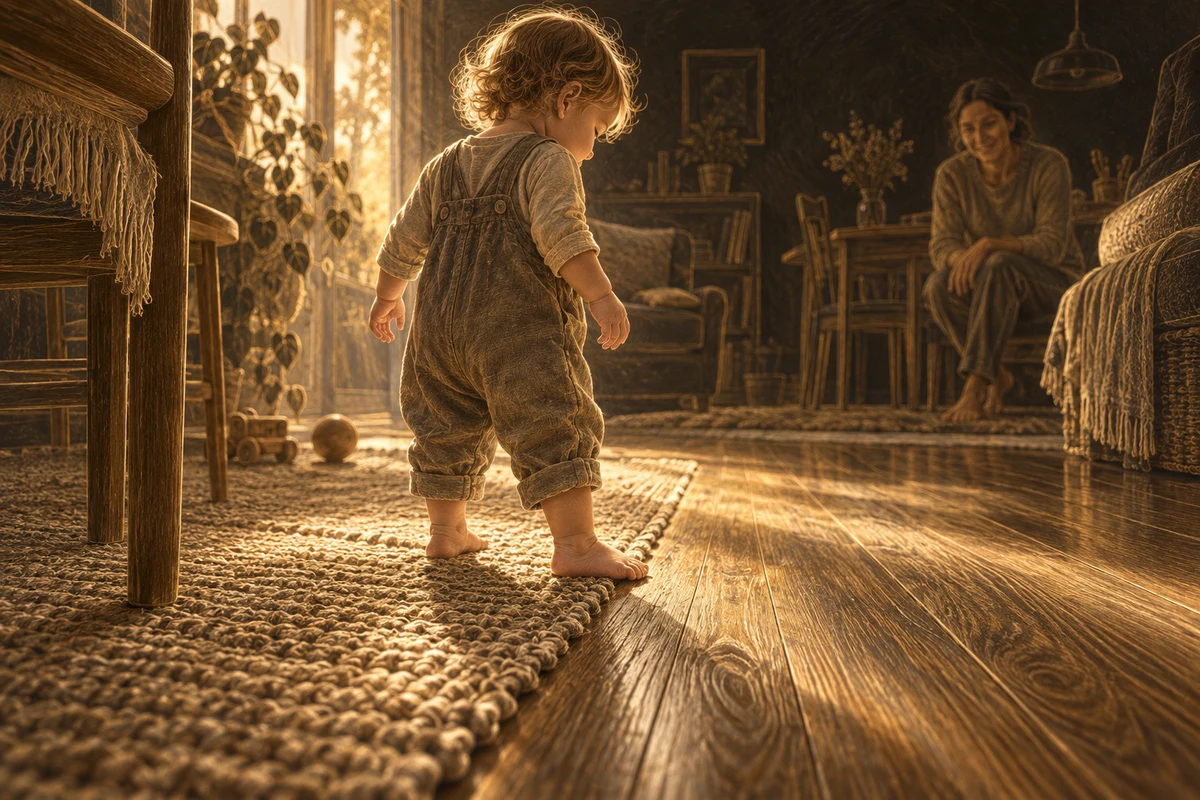
The other day I was watching my two-and-a-half-year-old daughter move through the house, and it struck me that she is not just seeing a smaller version of my world. She is living in a different one.
From where she stands, everything is close. The grain of the floorboards. The change from rug to wood. The hard lip of a doorstep. The cold of a tile. The corner of a table at head height. The speed with which a dog turns. The way a hand reaches toward her. The sudden tightening in a face before a voice changes.
Her world is low to the ground, yes. But more than that, it is still sharp.
Not because her eyes are better than mine. Because more of reality still matters in detail.
A grown adult walks across a room and sees almost none of this. The room has already been flattened. Floor. Table. Door. Chair. Safe. Familiar. Done. We move through it on compressed assumptions. The world has become a set of known territories, and known territories no longer need to be mapped with the same care.
But for a child, so much of the nearby world is still alive with consequence.
That surface might slip. That leaf might cut. That edge might hurt. That step might be too high. That expression might mean comfort. That tone might mean stop.
This, I think, is one of the hidden truths of development: the world is sharpest at the edge of what you are currently learning.
A toddler is not just learning "about objects." She is mapping three landscapes at once.
First, the ground: the world beneath and around her. Surfaces, edges, distances, weight, grip, balance, danger, invitation. The room is not background. It is alive with affordances. Every patch of it asks a question.
Second, the weather inside the body: the rush of fright, the wobble before a fall, the sting of a bumped knee, the fizz of excitement, the warm collapse of being picked up, the heavy ache of tiredness. A child is not only learning the room. She is learning what happens inside herself as she moves through it.
Third, the gaze: the charged field of other minds. The smile that opens the world. The face that hardens. The laugh that draws her in. The silence that leaves her outside. Long before she has the words for approval, rejection, safety, shame, or pride, she is already learning their shape.
So early life is lived at close range. The ground is sharp. The body is loud. The gaze matters enormously.
Then, slowly, things flatten.
Not because the world becomes less real, but because the map gets better.
What was once a thousand separate details becomes a type. A category. A shortcut. A patch of territory you no longer need to inspect so closely. The floor becomes just the floor. The room becomes just the room. The body becomes background hum. Familiar faces become part of the furniture of life.
This is efficient. It would be impossible to survive if everything remained equally vivid forever. The brain has to compress. It has to stop spending full attention on what it already understands. To know is, in part, to stop seeing in detail.
And yet this flattening does not end with childhood. It seems to continue all the way up.
At first, the high-resolution frontier is physical. Then it becomes social. Later it may become status, identity, belonging, competence, sexuality, work, systems, institutions, meaning. We move through layers of life, and each layer, when it first becomes urgent, appears in finer grain. We notice distinctions that previously did not exist for us. We become sensitive to cues we were once blind to. We learn a new patch of reality, and for a while it glows with detail.
Then, if we stay there long enough, it flattens too.
That may be one reason so many adult lives feel duller than they once did. Not because adulthood is inherently dead, but because so much of life becomes over-mapped. The same streets. The same routines. The same relationships. The same assumptions. The same role, performed so many times it no longer arrives in full colour. We stop living at the frontier and start living inside the map.
This is also why travel can feel so vivid. Time seems to stretch on holiday not simply because we are enjoying ourselves, but because our old models no longer carry us so cheaply. We have to look again. Street signs matter. Door handles matter. The sounds of a café matter. The distance from the station matters. The body wakes up. Attention thickens. The world regains texture.
For a little while, life becomes sharp again.
But the real lesson here is larger than travel. It is that vividness may not be some magical property of youth that vanishes forever. It may be what experience feels like whenever we are near a living edge — whenever we are in contact with something not yet flattened by familiarity.
A vivid life, then, might be one that keeps renewing its frontier.
Not necessarily through constant movement or novelty for its own sake, but through continued contact with the parts of reality one has not yet finished mapping. A new place. A new craft. A deeper interior honesty. A new language. A harder question. A new layer of self-understanding. The frontier can be out in the world, inside the body, or within the hidden architecture of the self. What matters is that some part of life is still alive enough to surprise us.
Because perhaps that is what sharpness really is: not youth, not innocence, not better eyesight, but the presence of unmapped consequence.
Children live there naturally. Adults usually have to find their way back.
And maybe that is one of the quiet tragedies of modern life: not that the world has lost its texture, but that we so often move through it using old maps, mistaking familiarity for reality itself.
The world did not become flat.
We flattened it by learning it.
Then we forgot that there were still other edges to find.